
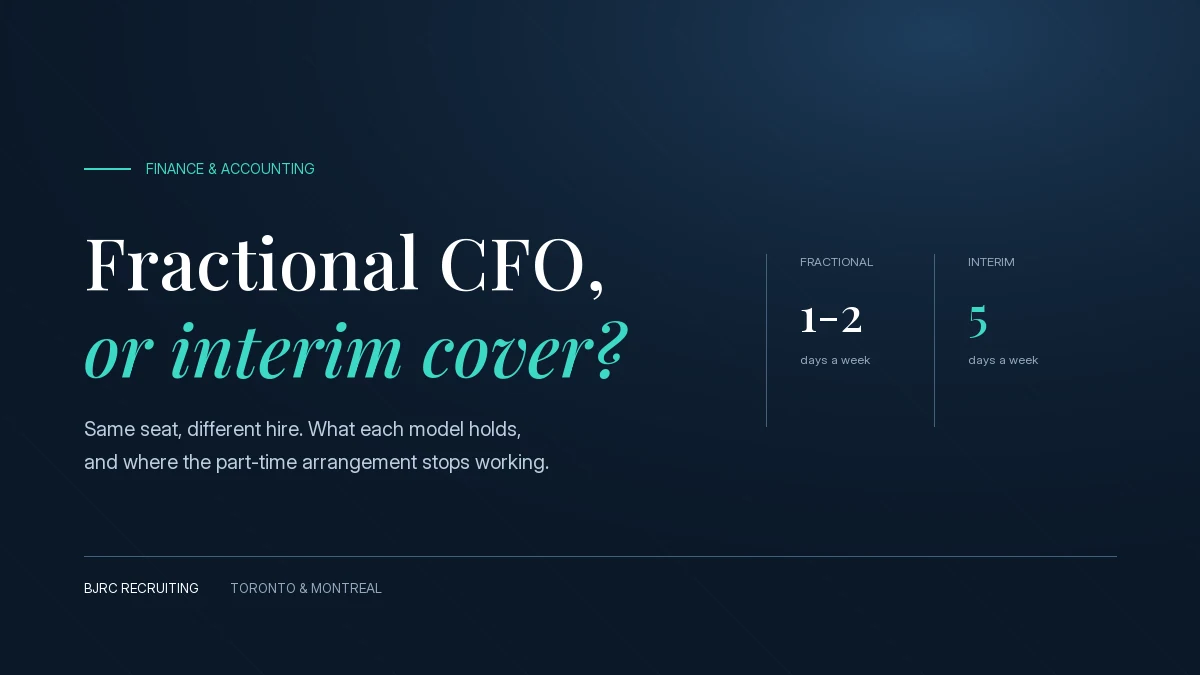
A fractional CFO gives a Canadian company senior finance leadership for part of a week on an ongoing basis, carrying chief financial officer duties on a part-time schedule, while an interim CFO holds a full-time seat for a fixed period. Both models put an experienced finance leader in front of your numbers without a permanent hire, so the real question is not which title sounds better, it is which one matches your stage, your budget and how fast the seat needs filling.
This guide covers what each model actually holds, where the part-time arrangement stops working, and how the hiring decision gets made once your finance strategy outgrows a few days a month. The comparison runs across scope, authority and cost, so you can make the call against your own stage rather than a generic definition.
What does a fractional CFO do inside a growing company?
A fractional CFO owns the forward-looking half of the finance function, not the month-end close. The mandate sits on planning, capital decisions and the guidance a leadership team needs before it commits, while day-to-day accounting operations stay where they already run. A growing business usually buys the role at the point where cash flow planning and capital decisions outgrow the founder's spreadsheet.
Which finance responsibilities sit with a fractional CFO?
A fractional CFO owns forecasting, cash flow planning, capital strategy and board reporting, the cluster of work that shapes decisions before the numbers are final. On a typical mandate, the deliverables look like this:
- Rolling 13-week cash flow forecast, refreshed against actuals
- Board and investor reporting packages carrying commentary, not raw exports
- Pricing and margin analysis that turns operational data into insights the executive team can act on
- Finance systems roadmap, from cloud accounting through to ERP selection
The role stops where technical execution starts. Month-end close, technical accounting positions, audit preparation and statutory reporting stay with the controller or the external accounting firm, so a fractional mandate adds senior judgment on top of a functioning close instead of replacing the people who produce it.
That split only holds if the books are ready. A part-time mandate assumes cloud accounting or a working ERP and a single source of truth, because a fractional CFO who arrives to reconstruct 8 months of transactions spends the retainer on cleanup rather than on analysis. Clean books let the mandate build on what already exists instead of rebuilding it.
How does a fractional CFO differ from an interim CFO?
A fractional CFO and an interim CFO differ on 4 dimensions: hours, duration, authority and fee structure. Both are chief financial officer roles, so what changes is how much of the seat a company buys and for how long.
Hours and duration split first: a fractional CFO works a set number of hours each month over a long horizon, often a year or more with no fixed end date, while an interim CFO holds full-time hours inside a window that closes on a date agreed upfront. Fractional hours accumulate as a rhythm, so continuity comes from repetition over time, while interim work compresses instead, and the experience a company buys is someone who has held that seat through the same transition before.
Scope of authority differs between fractional and interim CFOs
An interim CFO signs, reports and manages the finance team, so accountability transfers in full for the length of the mandate.
The interim holder runs performance conversations, owns the relationship with the auditor and the lender, and carries the leadership load a departing CFO left behind, which keeps accounting operations moving while the permanent search runs.
A fractional CFO advises the same team without absorbing its management chain, so escalation still lands on the CEO's desk.
Fee structures for fractional and interim CFO engagements
Fractional engagements usually run on a monthly retainer tied to an agreed hour band, sometimes hourly for narrow scopes, while interim mandates are priced as a day rate or a fixed-term contract cost that tracks a full-time schedule.
Canadian rates for both models swing widely by industry, company stage and seniority, so treat any published range as a negotiating starting point rather than a benchmark. Recruitment services sit on a different mechanic altogether: a contingent placement fee carries no upfront cost, so the sourcing and vetting work happens before anything is invoiced.
Fractional CFO and interim CFO compared side by side
| Dimension | Fractional CFO | Interim CFO |
|---|---|---|
| Weekly hours | 1 to 2 days a week | Full-time, 5 days |
| Typical duration | A year or more, open-ended | Fixed window with an end date |
| Hiring trigger | Growth, financing, board pressure | Sudden departure, ERP go-live, year-end close, leave |
| Scope of authority | Advisory, no direct reports | Full authority, manages the finance team |
| Fee model | Monthly retainer or hourly | Day rate or fixed-term contract |
| Exit path | Scales down, or shapes a permanent hire | Handover to the permanent CFO |
How many days a week does a fractional CFO actually work?
A fractional CFO usually works 1 to 2 days a week, either as fixed days or as a monthly block of hours the company draws down as it needs them. That cadence holds for most of the year, then flexes upward around the close, a financing round or a board meeting, when cash forecasts get rebuilt weekly.
Whatever the shape, the mandate should state the hours, what happens when the scope runs past them, and who approves the overage before it reaches an invoice. Most arrangements track time in a monthly log against agreed deliverables.
How do you hire a fractional or interim CFO in Canada?
The model matters less than the process that fills it. A fractional CFO and an interim CFO both live or die on scoping and vetting, so run the same 5 steps whichever one you hire:
- Define the mandate and the hours before you speak to anyone
- Benchmark the rate against comparable Canadian roles at the same stage
- Shortlist senior finance candidates on sector and stage fit, not title history
- Reference-check delivery rather than tenure, asking what shipped and what stalled
- Set a written handover plan covering documentation, systems access and the exit date
Who runs the search changes the shortlist. Specialist finance and accounting recruitment in Toronto does its work on the vetting layer, where recruiters who practised in the field, bar-called lawyers, CPA-designated finance leaders and management consultants, read a candidate's real industry experience instead of matching keywords on a resume.
Named-consultant accountability holds that standard in place, because the person who scoped the mandate runs the search through to the hire, with support from a bench that has spent years helping companies across Toronto and Montreal fill the same roles.
What gets placed, and what sits outside that scope
The scope is narrow on purpose: interim and contract finance leaders on defined mandates, plus permanent CFO, VP Finance and Controller searches, for mid-market companies under 500 employees, scaling businesses and PE-backed portfolio companies.
A monthly fractional advisory retainer sits outside that line, because executive finance leadership at this level is bought either as a hire or as consulting hours, and the 2 markets barely overlap. A 90-day replacement guarantee on a contingent placement covers the hire itself, which is a different promise from buying advisory hours.
Fractional CFO, interim cover or a permanent controller: which hire fits?
3 hires answer 3 different problems, and the trigger is decision complexity rather than headcount. A fractional CFO buys senior judgment for part of a week, interim cover holds a full-time seat for a fixed window, and a permanent controller builds the reporting engine that sits underneath both.
Companies grow into this decision, so the ones that scale fastest read the key signals below before they settle on a job title. The test is whether the business needs senior judgment a few days a month, full-time coverage for a season, or permanent reporting capacity in-house.
Complexity signals that push a company past bookkeeping support
The signals that push a company past bookkeeping support are structural: multiple legal entities or currencies on one set of books, several reporting stakeholders who each want a different cut of the same numbers, margin pressure that needs analysis instead of recording, and a financing cadence moving faster than the close.
Small businesses dominate the Canadian economy, and 98% of Canadian businesses employ under 100 people, so most of these decisions get made without a finance department in the building. The cost of getting them wrong tracks the operational complexity underneath rather than the revenue line.
Financing events that justify fractional CFO support
A raise, a lender covenant or an acquisition means model-ready numbers on a deadline, so someone senior has to author them. Fundraising exposes the gap fastest, because investors test the assumptions behind the model and a founder defending a forecast they did not build loses the room.
That is the strategic case for senior finance authorship at financing stage, and the 41% of Canadian CFOs who also carry operations shows how wide the remit already runs before a transaction is added to it.
That authorship gap shows up again in the board pack, which needs commentary rather than a raw export, because directors and investors are not short of reporting, they are short of interpretation on which decisions land next quarter.
If your last board meeting turned into a numbers-accuracy debate instead of a strategy conversation, the gap is insights, not spreadsheets. Those signals all point at part-time senior help, and a different set points at someone in the seat 5 days a week.
Which signals point to an interim CFO rather than a fractional CFO?
An interim CFO earns a full-time seat in 3 situations, and they share one trait: the finance calendar holds a deadline that cannot move. A sudden departure, an ERP cutover or a year-end close under audit pressure each put reporting continuity at risk, which is why the company needs finance leadership in the chair daily instead of the part-time judgment a fractional CFO provides.
A sudden CFO departure requires full-time cover
If a CFO departure lands without notice, part-time hours cannot hold a reporting calendar that is already in motion.
That scenario has become more common as the role has turned over faster. Average CFO tenure in Canada fell to 4.2 years in 2020, down from more than 5 years a decade earlier, so interim cover is a recurring requirement rather than an emergency measure. An interim CFO absorbs the reporting load and keeps the team working under one line of leadership.
ERP go-lives, year-end close and deal deadlines demand daily ownership
Unlike advisory work that can be batched into scheduled sessions, an ERP go-live demands ownership every day of the week. Data migration calls and cutover sign-offs arrive hourly, and each one commits the accounting operations that run on the new systems for years afterward.
The year-end close behaves the same way: audit queries and consolidation adjustments move on the auditor's clock, so a finance leader who is available on Tuesdays becomes the bottleneck.
A live transaction runs on someone else's calendar too. Building the data room, owning the analysis behind every schedule and turning around follow-up questions within a day takes full-time bandwidth, while capital structure and exit strategy conversations continue in parallel.
An interim CFO carries both loads, which keeps management focused on the deal. Interim cover closes a gap on a fixed date, while a fractional arrangement can shape the permanent role that comes after it.
Can a fractional CFO bridge to a permanent finance hire?
A fractional CFO can bridge to a permanent finance hire, and the bridge is often worth more than the coverage itself. The mandate shapes the role before the company ever recruits for it: writing the scorecard that defines what the hire owns, benchmarking the pay band against comparable senior roles, and building the reporting stack the successor inherits on day 1.
Continuity is the other half of the value. A part-time leader who has already run 4 quarters of forecasts knows which assumptions hold and which team members carry the institutional knowledge, so the handover covers judgment rather than file locations, and a predecessor with no stake in defending the numbers has no reason to hide the thin spots.
Important note: if the fractional mandate ends before the permanent leader starts, the reporting cadence slips in the gap. Overlap the 2 engagements by a few weeks and make the handover a deliverable, not a courtesy.
Where the path ends is a search, not a retainer. The fractional CFO defines the mandate, and a specialist recruiter fills it with a permanent CFO, VP Finance or Controller whose operating experience matches the stage the company has reached. That is a hiring decision rather than an advisory one, so the shortlist is drawn from executive finance candidates who have run the function at the same scale. A contingent structure keeps that step low-risk, since the placement fee lands when someone is hired rather than when the search opens.
When does a fractional CFO stop making sense?
A fractional CFO stops making sense once the finance function needs daily ownership instead of periodic judgment. 3 thresholds tend to arrive together as a company scales: the team grows past what a part-time schedule can supervise, the retainer starts to rival what a salary costs, and the decisions that matter begin waiting for the next session.
Headcount and reporting lines outgrow a part-time CFO
A part-time CFO can guide a finance team of 2 or 3 people, but once several analysts, a controller and a shared services layer report into the seat, supervision turns into daily work: performance conversations, workload allocation, and review of every reporting package before it leaves the department.
When finance management extends into IT, HR or site operations, as it usually does once a company grows past a single location, the leader has to be present for decisions taken somewhere other than the finance floor.
Full-time ownership becomes cheaper than fractional hours
Compared with a retainer that grows every quarter, a salaried CFO can cost less per unit of attention. A retainer priced for 2 days a week climbs as the scope creeps, while a full-time salary buys 5 days inside a fixed budget.
Running that comparison honestly takes real figures rather than assumptions, so Canadian salary benchmarks for senior finance roles belong in the model before either option is priced.
Availability costs of a part-time finance leader
If decisions stall between sessions, the company pays in delay rather than in fees. A pricing approval or a hiring sign-off that waits 6 days for a scheduled review has already cost more than the hours it saved, and that lag compounds in any quarter where the plan changes monthly.
Availability also governs the work that never appears on a mandate: board access between meetings, coaching a controller through a first audit, and being in the room while the leadership team argues a trade-off. Those are the key moments where a full-time leader picks up insights a scheduled session never captures.
Talk to BJRC Recruiting about fractional and interim CFO coverage
Whether the next 12 months call for a fractional CFO, an interim CFO or a permanent hire comes down to how much of the seat has to be filled.
BJRC Recruiting places CFOs, VP Finance, Controllers and interim finance leadership with mid-market, scaling and PE-backed companies in Toronto and Montreal, through recruiters who held CPA-designated finance roles before they moved into search. Book a free hiring consultation, and the team will help scope the mandate before it reaches the market, then bring the finance support that matches it.
Frequently asked questions about fractional CFO engagements
How quickly can a company bring in a fractional or interim CFO?
Speed depends on how tightly the mandate is scoped, not on the size of the candidate pool. Cover needed after a sudden departure moves faster than a discretionary hire, so expect a range rather than a fixed lead time.
Can a fractional CFO support a bilingual Montreal finance team?
Yes, provided the bilingual requirement is written into the mandate before the search starts. Quebec operations often need board materials and management reporting produced in French, alongside a finance team that works in both languages.
Does a fractional CFO need a CPA designation?
If the mandate touches audit readiness, complex revenue recognition or a first consolidation, a CPA designation carries real weight because the work sits in technical accounting territory. A mandate built around fundraising, forecasting and capital planning weighs years of operating experience in the same industry more heavily, and many effective fractional CFOs come through that route instead.
Who manages the finance team while a fractional CFO is engaged?
Daily supervision of the finance team normally stays with the controller or the finance manager, since a fractional CFO gives guidance without absorbing the management chain. The mandate should name who approves payments, who owns the close and where escalation goes when the CFO is not in the building.