
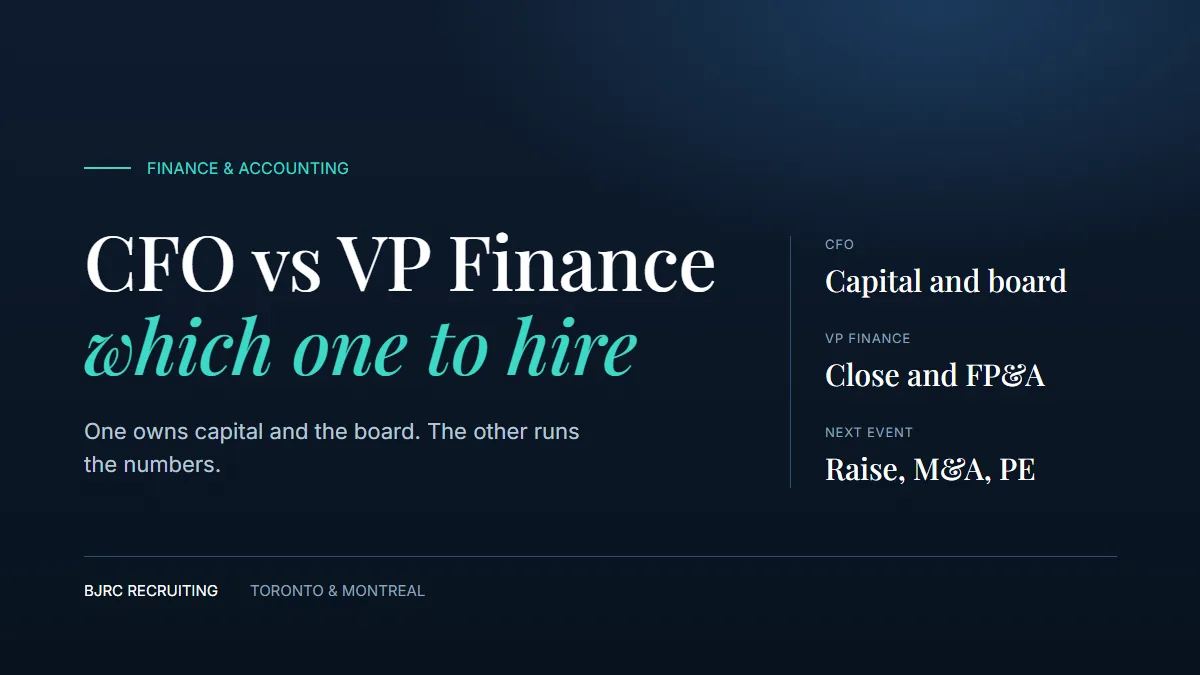
CFO vs VP Finance comes down to a single difference: a company needs a CFO when capital, investors and the board call for a strategic owner of its finances, and a VP Finance when it needs a senior leader to run finance operations with rigour.
The right choice depends less on revenue than on the decisions the finance function will face next, and reading those decisions tells you which of the two to hire now. The comparison starts with the reporting line, because the VP Finance usually reports to the CFO, who answers to the CEO and the board.
Key Differences Between a CFO and a VP Finance
CFO vs VP Finance differences lie in scope, authority and reporting line. The chief financial officer (CFO) is a C-suite officer who owns financial strategy and capital, while the vice president of finance, or VP Finance, runs day-to-day finance one level below, under the CFO. The two overlap only in reporting, and even there they serve different audiences: the board and investors for the CFO, the controller and the finance team below for the VP Finance, who answers for execution.
Scope of the CFO Role at the Top of the Finance Function
A CFO owns the company's financial direction, from how it raises and spends capital to what it tells investors and the board. The mandate usually rests on 4 pillars:
- Capital structure and funding: the mix of debt and equity, banking relationships and the timing of each raise.
- Investor and board relations: board and audit committee reporting, investor updates and lender negotiations.
- Long-term planning: the multi-year plan, capital allocation and the growth bets it funds.
- Financial risk: treasury, liquidity and the oversight of the controls that protect the numbers.
The CFO is judged on decisions: which projects get capital, when to raise, and how the company's numbers hold up under investor scrutiny. Those 4 pillars also give a ready interview agenda when hiring for the role.
The VP Finance Role in Day-to-Day Finance Operations
The VP Finance runs the finance department day to day, from FP&A, budgeting and forecasting to the month-end close and management reporting. That split means that while the CFO decides the company's direction, the VP makes sure the numbers that guide it are accurate, on time and backed by sound internal controls.
Overseeing the controller, the accounting team and the FP&A analysts, the VP is measured on operational execution, and the proof is a clean close and a forecast operating leaders trust, with analysis they can act on. A job description limited to these duties describes a VP Finance, whatever title it carries.
CFO vs VP Finance Side by Side on Scope, Reporting and Mandate
CFO vs VP Finance roles sit a level apart in the organization, and the CFO owns every line of the mandate where the board or investors are involved:
| Dimension | CFO | VP Finance |
|---|---|---|
| Primary focus | Financial strategy, capital and risk | Finance operations, FP&A and reporting |
| Seniority | C-suite, the most senior finance officer | Senior leader, a level below the CFO |
| Reporting line | CEO, with a direct line to the board | CFO in most companies |
| Board and investor exposure | Leads board, lender and investor discussions | Prepares the numbers, attends when asked |
| Typical stage | Fundraising, M&A, private equity ownership or a listing | Growing company that needs a disciplined close and forecast |
| How success is measured | Capital raised, decisions made, credibility with investors | Accuracy, timeliness and control of the numbers |
Growth Stages That Call for a CFO or a VP Finance
Growth stages decide the CFO vs VP Finance choice through complexity and funding events more than revenue or headcount. A VP Finance fits the stage where the numbers need control, and growth that brings lenders, investors or a capital raise moves the need to a CFO.
Revenue and Complexity as Decision Factors
Revenue and complexity both matter, but complexity decides first: no single revenue figure tells a company when to hire a CFO. Two companies with the same revenue can need very different finance leadership, for example when the first has a single entity and simple pricing and the other has subsidiaries, foreign currencies, project accounting or lender covenants.
The second needs strategic decisions on its finances sooner, driven by heavier reporting demands, and 4 signals of that complexity bring a CFO hire forward:
- Several legal entities or countries to consolidate
- Debt with covenants to report against
- A board or investors asking for monthly data packages
- Contracts, pricing or inventory that make margins hard to read
Early-Stage Finance Needs Before a Full-Time CFO
Early-stage finance needs are mostly accounting, cash management and basic reporting, so young companies rarely need a full-time CFO. A founder usually covers that work with a bookkeeper or a controller, and the first senior finance hire is often a VP Finance, once the close and the cash forecast need an owner.
A permanent CFO stays premature as long as the operational finance load comes with no capital raise, board reporting or acquisition on the plan.
Fundraising, M&A and PE Backing as CFO Triggers
Fundraising, M&A and private equity (PE) ownership are the clearest triggers for a CFO hire. Each puts investors and the board at the table, with capital structure questions a VP Finance is not mandated to own:
- Equity or debt raise: a priced round, a growth equity deal or new bank debt, where investors expect a finance leader who can defend the model.
- Acquisition or sale: due diligence, valuation, integration and the data room.
- PE ownership: monthly board reporting, a value creation plan and lender reporting, built around an exit.
- Public listing: the move to public company reporting and an audit committee.
A mistake in front of investors costs more here, and the risk falls on the finance leader, so hiring the CFO before the event starts is safer: the person who negotiates the deal then owns its long-term results.
The Path From VP Finance to CFO
A VP Finance can grow into the CFO role, but the promotion depends on adding strategic skills and experience that operational leadership does not build on its own. The company's growth decides how fast that gap has to close, so it is the first point to assess in an internal candidate.
Strategic Capabilities a VP Finance Needs for the CFO Role
A VP Finance needs 5 strategic capabilities to move into the CFO role:
- Capital markets: structuring and negotiating equity or debt.
- Investor relations: presenting results and the plan to investors and lenders.
- Board communication: turning financial analysis into decisions a board can make.
- M&A: running due diligence, valuation and integration.
- Treasury: managing liquidity, banking relationships and financial risk.
These capabilities separate owning the finances from executing them, which is why a VP who has sat in board meetings and worked on a raise brings experience that skills on paper do not show.
Conditions for a Successful Internal Promotion to CFO
An internal promotion to CFO works when the VP Finance already carries part of the strategic agenda and the company's next event matches that experience.
A promotion tends to succeed when:
- The VP has presented budgets and forecasts to the board
- The next capital event is one the VP has already worked on
- The CEO treats the VP as a strategic partner rather than as the head of reporting
An external CFO hire is the safer route when:
- A first institutional raise, an acquisition or a PE sale is coming
- Investors or lenders require a CFO with a track record in that kind of deal
- Finance operations still need the VP in place
A promotion keeps growth opportunities open inside the team, while an external hire lowers the risk on decisions nobody in the company has handled before, which makes it the right call for a first major transaction.
Fractional and Interim CFO Options Before a Permanent Hire
A fractional CFO is a part-time finance chief shared by several companies, and an interim CFO is a full-time but temporary one: both cover the strategic finance work before a permanent hire. The fractional model suits a growth company that needs board and capital experience for a raise, a forecasting model or board preparation without paying a full-time salary, while the interim model covers a vacancy, a leave or a transaction until a permanent CFO starts.
Both options fit a company whose need for strategic decisions on its finances is real but not yet constant: operations stay with the VP Finance or the controller, and the part-time or temporary CFO adds the strategic layer on top.
The Cost of Hiring a CFO or a VP Finance in Canada
The cost of hiring a CFO in Canada is well above the cost of a VP Finance: government figures put the CFO median far above the median for financial managers. For the organization, the true cost of either senior hire also includes the search and the ramp-up time, plus the capital at stake if the choice is wrong.
CFO Base Pay, Bonus and Equity in Canada
A CFO in Canada earns a median base wage of $96.15 an hour, roughly $200,000 a year at 40 hours a week, before any bonus or equity, according to Government of Canada wage data for CFOs from the Statistics Canada Labour Force Survey (NOC 00012, reference period 2023-2024). The range runs from $51.28 an hour at the low end to $153.85 at the high end. The Toronto region median matches the national figure.
These wages cover base pay only, with bonus, long-term incentives and equity on top, and those vary with ownership and stage, so CFO compensation in Canada should be compared with companies of the same size, sector and funding.
VP Finance Pay in Toronto and Montreal Compared With CFO Pay
VP Finance pay runs at about 62% of CFO pay in Canada, based on the closest government benchmark for the role: the financial managers group (NOC 10010), which covers finance directors and the managers who run finance operations. Its national median is $59.48 an hour, with a low of $38.50 and a high of $91.76 (same source and period).
| Region | Median hourly wage, financial managers |
|---|---|
| Toronto region | $62.37 |
| Montreal region | $63.46 |
Montreal sits slightly above Toronto at this level, so a Montreal search should not budget below Toronto pay. In both cities, the gap with the CFO grows toward the high end of the range, because the VP role is built around reporting rather than capital decisions.
The Hidden Cost of a Senior Finance Mis-Hire
A senior finance mis-hire costs more than the salary paid, because it adds a second search and lost time: reporting deadlines slip and the cash forecast weakens while the seat turns over, and financing opportunities can pass until the replacement is up to speed.
Turnover in the role is already frequent: CFOs at US public companies stayed an average of 2.1 years, the shortest tenure in the C-suite, according to a Datarails study of 1,991 companies reported by CFO.com (US data).
A wrong choice between the 2 roles carries its own cost, since a CFO hired too early can leave for lack of strategic work and a VP Finance hired into a CFO agenda faces decisions beyond the mandate. Settling the mandate before the search starts reduces that risk.
Evaluation Criteria for CFO and VP Finance Candidates
Evaluation criteria for CFO and VP Finance candidates follow the mandate, not the title on the résumé: the employer tests a CFO on strategy and capital and a VP Finance on execution and control. The specific experience and skills to look for differ for each.
Core Competencies of a CFO Hire
A CFO hire needs 5 competencies, the last one only in a PE-backed company:
- Strategic finance: building the long-range plan and the capital allocation behind it.
- Capital raising: a track record with equity, debt or both, at the company's scale.
- Investor and board readiness: presenting to a board and handling investor questions without the CEO in the room.
- ERP and systems: owning a finance system implementation as the company grows.
- PE experience: value creation plans, lender reporting and exit preparation for PE-backed companies.
Scoring each finalist on a mid-market CFO scorecard turns these competencies into weighted criteria, so the comparison rests on the skills the company's growth plan needs.
Screening Points for a VP Finance Candidate
A VP Finance candidate is screened on 5 points that show whether finance operations will run without the CFO stepping in:
- FP&A depth: forecasting models and budget cycles that operating leaders trust.
- Close and reporting rigour: a predictable month-end close and management reporting on a fixed calendar.
- Team leadership: overseeing controllers, accountants and analysts, and developing them.
- Systems and analysis: running the ERP and reporting tools, and turning their output into financial analysis.
- Internal controls: designing and testing them so they hold up in an audit.
Situations Where a Specialist Finance Recruiter Adds Value
A specialist finance recruiter adds the most value when the search is senior, confidential or tied to a specific market:
- Confidential replacement: the current CFO or VP Finance is still in the seat.
- Thin candidate pool: PE, M&A or sector experience narrows the market.
- Bilingual search: a Montreal role where French is part of the mandate.
- Open mandate: the company is still choosing between a CFO and a VP Finance and wants the market to inform the scope.
For a routine hire with a clear profile and strong applicant flow, an internal search can find the right candidate.
Make the Right CFO or VP Finance Hire With BJRC Recruiting
Choosing between a CFO and a VP Finance comes down to the scope your company needs today and the one it will need after its next financing or growth stage.
At BJRC Recruiting, we help you define that mandate first, and the recruiter who scopes it with you is the one who runs your search.
Book a consultation with our finance recruitment team.
Frequently Asked Questions About CFO vs VP Finance Roles
Can a Controller Become a CFO?
Yes, though the path usually runs through a VP Finance role first, where FP&A, forecasting and board reporting are added to accounting expertise. In a smaller company the step can be direct, since the controller often reports to the chief executive and is already responsible for most internal finance work. The move is more likely to succeed when the controller has also handled a raise, a lender negotiation or an audit within the company.
Can One Person Be Both the CFO and VP Finance?
Yes, it's common in small businesses, where a single senior finance leader may hold the CFO title while still running the day-to-day close. The roles often split when raises, board meetings and acquisitions take so much of that person's time that operations start to slip.
What Are the Key Differences Between a Controller and a CFO?
A controller runs accounting, the close and its deadlines, while a CFO sets financial goals, owns long-range planning and makes the case to investors. A strong controller is enough while the company's plans stay simple, and when capital or board work is present on the agenda, a VP Finance or a CFO fills what the controller role was not built to do.
How Does a Director of Finance Compare With a VP Finance and a CFO?
A Director of Finance usually sits a level below a VP Finance and runs hands-on finance work such as budgeting, reporting and analysis for a department or business unit. The exact title and its weight vary with company size: in a small company that director can lead the finance function, while a large company may have several, and the CFO sits above both and owns the strategy.